Pages

Showing posts with label Stock market. Show all posts

Tuesday, January 22, 2013

Stock News 2013: PSE okays thrift bank’s P4.25-B IPO

Philippine Business Bank Logo
Philippine Business Bank Logo (Photo credit: Wikipedia)

The Philippine Stock Exchange has approved an initial public offering worth up to P4.25B by Philippine Business Bank, marking the first Philippine stock market debut for this year.

PBB, the thrift banking arm of the Zest-O group of businessman Alfredo Yao, is set to offer up to 101.33 million in primary shares to the public for as much as P41.94 per share, based on the offering circular released by the PSE. This will bring to public hands about 30 percent of the bank’s post-IPO capital.

The IPO pricing is set to be finalized by February 4 while the offer period will run from Feb. 6 to 12.  Tentative listing date is on Feb 19.

The joint lead underwriters for the issuance are First Metro Investment Corp. and SB Capital Investment Corp.

Proceeds from the offering will be used to finance the bank’s lending activities and also to fund the acquisition of investment securities.

In addition, about P400 million will cover capital expenditure requirements in connection with its branch network expansion program, including the acquisition of new branch banking licenses, the development and implementation of IT (information technology) infrastructure and applications projects.

After the IPO,  Yao (with 37.26 percent) and Zesto Corp. (with 25.17 percent) will remain as the key shareholders of PBB.

http://business.inquirer.net/103073/pse-okays-thrift-banks-p4-25-b-ipo-first-for-2013

Enhanced by Zemanta

Friday, July 8, 2011

Stock News 2011: SSS to increase equity portfolio

Value of Polish Allianz Open Pension Fund unit...Image via Wikipedia
State-run Social Security System (SSS) said Thursday that it plans to boost its investment in the equities market as the pension fund is looking at increasing its holdings in power and mining.

Emilio de Quiros Jr., SSS president and chief executive said the agency will raise its equity holdings from the current 21 percent, adding that its charter allows them to invest up to 30 percent of its entire investable fund in stocks.

De Quiros cited that SSS, which provides benefits to Philippine private sector workers, has roughly P286 billion worth of investable fund.

If SSS board decides to raise its publicly listed stocks holdings to 30 percent, it would mean additional P20 billion in placement.

Analysts said the Philippine Stock Exchange index (PSEi) may reach the 5,000 level this year amid strong investor confidence.

De Quiros earlier said that the pension fund is planning to increase its revenues from contributions.

http://mb.com.ph/articles/325886/sss-increase-equity-portfolio


Enhanced by Zemanta

Wednesday, August 25, 2010

International News 2010: The Hindenburg Omen IS Scary, but So Are the Fundamentals

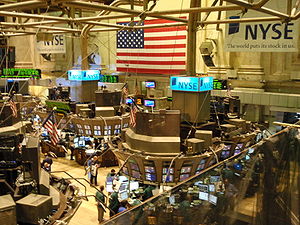
A view from the Member's Gallery inside the NYSEImage via WikipediaAfter tumbling below 10,000 yet again Wednesday morning, the Dow rebounded to close above that psychologically important level and was slightly higher early Thursday. Still, fear in the market is being expressed by the continued rally in Treasuries and widespread chatter about an ominous sounding technical indicator: The Hindenburg Omen.
The Hindenburg Omen has a roughly 25% accuracy rate in predicting big market upheaval since 1987, meaning it's far from infallible but isn't inconsequential either. The indicator's creator, mathematician Jim Miekka, compares the Hindenburg Omen to a funnel cloud that precedes a tornado in a recent interview with The WSJ. "It doesn't mean [the market's] going to crash, but it's a high probability," he said.
Complex and esoteric even in the world of technical indicators, the Hindenburg Omen is triggered when the following occurs, Zero Hedge reports:
-- The daily number of NYSE new 52-week highs and the daily number of new 52-week lows must both be greater than 2.2% of total NYSE issues traded that day.
-- The NYSE's 10-week moving average is rising.
-- The McClellan Oscillator (a technical measure of "overbought" vs. "oversold" conditions) is negative on that same day.
-- New 52-week highs cannot be more than twice the new 52-week lows. This condition is absolutely mandatory.
These criteria have been hit twice since Aug. 12, prompting Miekka to get out of the market entirely, The WSJ reports. Judging by the recent market action, many others are following suit -- or at least moving in the same direction.
Worry List Lengthens
As Henry and I discuss in the accompanying clip, there are a lot of reasons to be worried right now that having nothing to with The Hindenburg Omen, the "Death Cross", Mercury being in retrograde or myriad other indicators cited by market pundits of various stripes.
More fundamental reasons to be concerned include:
It's the Economy, Stupid: This week's weak durable goods and home sales reports are just the latest in a string of desultory data. In sum, the macroeconomic data strongly suggest the job market isn't going to improve anytime soon. And if the job market doesn't improve, there's really not much hope for a turnaround in housing, consumer sales or anything else really. Oh, and the stock market is still expensive on a cyclically adjusted P/E basis, making it more vulnerable to an economic slowdown.
Unusual Uncertainty: On July 21, Fed chairman Ben Bernanke testified on Capitol Hill that the Fed's forecast called for real GDP growth of 3%-3.5% for 2010 and 3.5%-4.5% in 2011 and 2012. Less than a month later, the Fed announced plans to buy Treasuries again (a.k.a. "QE2") and, as The WSJ reported this week, there's a tremendous amount of dissention within the Fed about the 'right' policy prescription.
Financial Follies: Whether it's renewed concerns about Europe's sovereign debt crisis, more U.S. bank closures or reports of commercial developers walking away from properties, it's clear the problems in the financial system were not resolved by various and sundry bailouts and government stimulus ... not by a long shot.
Good Politics vs. Good Economics: S&P's downgrade of Ireland's debt and Greece's revenue shortfall show the short-term perils of the austerity measures that have swept Europe. But promising to cut government spending and slash deficits appears to be a winning political strategy in America right now. Certainly, it's a key message of Republican and Tea Party candidates, who appear to have the momentum heading into the November mid-term elections. But if Europe's 'PIIGS' are any example, gridlock might not be so "good" for the economy this time around, much less the financial markets.
Of course, the "good" news here is that there's so much to worry about and the markets typically are darkest just before dawn.
Aaron Task
August 25, 2010
Enhanced by Zemanta

Monday, August 23, 2010

International News 2010: The Next Bubble? Investors Flee Stocks in Droves In Favor of Bonds

NEW YORK - SEPTEMBER 17:  Traders work on the ...Image by Getty Images via @daylifeIndividual investors are fed up with the stock market. Burnt by 10 years of negative returns, two crashes, and a current economy mired with high unemployment and lackluster growth, many are throwing in the towel.
Investors have pulled $33.12 billion from U.S. mutual funds this year through July, according to the Investment Company Institute, the mutual fund industry trade group. With the exception of 2008 (height of the financial crisis), that’s on pace to be the worst year for stock funds since the 1980s, reports The New York Times.
What’s interesting is, this mass exodus comes at a time when stocks are holding up relatively well, as Aaron and Henry point out in this clip. The Dow Jones Industrial average has been volatile but is down less than 2% this year. Not exactly crash territory.
The next bubble?
Investors are fleeing the stock market in favor of bond funds. It’s happening at such a staggering rate, Bloomberg compares the flood of money into bonds to the stock market bubble surrounding the dot.com craze:
“Investors poured $480.2 billion into mutual funds that focus on debt in the two years ending June, compared with the $496.9 billion received by equity funds from 1999 to 2000, according to data compiled by Bloomberg and the Washington-based Investment Company Institute.”
Contrarian investors view this exuberance for fixed-income funds as a potential signal of the beginning of a new bull market in stocks.  Plus, there could be another enemy lurking in the wings for bondholders, as Aaron and Henry discuss: If inflation takes hold, as many predict it will, bonds will get “hammered.”
http://finance.yahoo.com/tech-ticker/the-next-bubble-investors-flee-stocks-in-droves-in-favor-of-bonds-yftt_535357.html;_ylt=AjsgIZYN4G4XlAwQJ50PU2Peba9_;_ylu=X3oDMTFnbmN1Ymc2BHBvcwMzBHNlYwNjb250ZXh0dWFsLXRlY2h0aWNrZXIEc2xrA3RoZW5leHRidWJibA--
Enhanced by Zemanta